Out-of-Stock Products on Shopify: Keep, Hide or Redirect for Google and AI Shopping
By Thomas Vu · Published
When a product sells out on Shopify, keep its page live and clearly marked as sold out if it's coming back, move it to the bottom of its collections, and only hide or redirect products you've retired for good. Hiding a product that will be back in two weeks can remove it from Google, from Shopify's Shop app and from AI shopping channels at the same time, and it has to earn its place again when it returns.
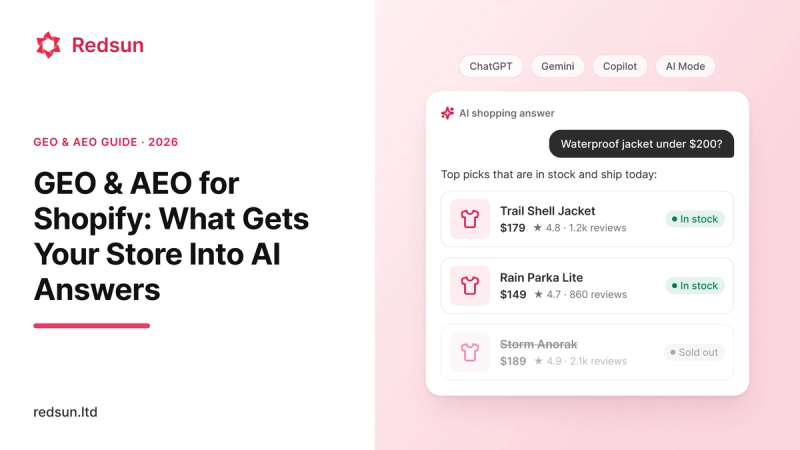
That matters more in 2026 because AI assistants now pick products for shoppers. When someone asks ChatGPT for "a waterproof jacket under $200", the assistant picks a few products from many, and stock status is one of the few signals in that choice you control completely. This guide covers what the platforms say about availability, the rules Google applies to sold-out pages, what each Shopify hiding option actually does, and a simple way to decide what to do with each product.
Key takeaways
- Availability is a ranking input. OpenAI says ChatGPT ranks merchants partly on availability, and Shopify lists availability among the signals AI channels can use.
- Your page, feed and structured data must agree. Google disapproves Shopping products whose landing page shows a different stock status from the feed.
- Google relaxed its sold-out page rule in 2026. A clear "Sold out" label or a greyed-out buy button is enough. Greying out only the sold-out variants also works.
- On Shopify, hiding a product hides it from Google and AI channels at once. The Unlisted status and the seo.hidden metafield both keep a product out of Shopify Catalog, which feeds AI channels, and out of search engines.
- One question decides it: is the product coming back? If yes, keep it live and push it down. If no, archive it and redirect its URL to the closest replacement or its collection, never the homepage.
Why availability now affects AI recommendations
AI shopping assistants rank products partly on whether they're in stock, and the platforms say so in their own documentation.
Platform | What it says about availability | Source |
|---|---|---|
ChatGPT | When several merchants sell the same item, they're ranked on availability, price, quality and whether the store is the maker or primary seller | |
AI channels connected to Shopify | Ranking varies by platform but can include data quality, relevance, availability, pricing and engagement | |
Shopify listing quality | The "variant & option completeness" signal measures your variants, options and their in-stock availability | |
Shopify Catalog | Continuously updates your product data so inventory and pricing stay accurate across AI channels |
Two practical points follow. First, turn on inventory tracking for every product and variant, or Catalog has no accurate stock to send. Second, because Shopify's listing quality signal looks at in-stock availability across variants, the same product probably scores lower with most of its sizes sold out than with all of them in stock. Shopify doesn't publish how much weight that signal carries, so treat it as a likely effect, not a rule.
You can check your own products. In your Shopify admin, the search preview in Sales channels > Agentic lets you run search queries and see how your products might rank in Shopify Catalog, with a listing quality meter for each product. Shopify says to treat it as a directional signal, not an exact prediction (Shopify Help Center). Our guide to GEO and AEO for Shopify covers the rest of what gets a store into AI answers.
The rules Google applies to sold-out products
Google's guidance on generative AI search says Merchant Center feeds can help your products appear in AI responses as well as in other Search results (Google Search Central). So Merchant Center's availability rules affect your AI visibility too. Three of them matter for stock.
- The page, feed and structured data must agree. If your landing page or checkout shows a product as out of stock while your feed says in stock, Google disapproves it. The reverse also triggers a disapproval (Google Merchant Center Help).
- The sold-out status must be visible on the page. Google's landing page requirements let you show it with clear text such as "Sold out" or "Item not available", or with a greyed-out buy button. On a product with variants, you can grey out only the sold-out options in the variant picker. If you still take orders, the page needs an active buy button, and backorders must show the expected shipping date (Google Merchant Center Help).
- "Out of stock" is only for temporary gaps. Google says not to set availability to out_of_stock for products you no longer sell, and to remove discontinued products from your product data instead (Google Merchant Center Help).
The second rule changed during 2026. In March, Google's requirements were reported as making a greyed-out buy button mandatory for sold-out products (Search Engine Land). By May, Google had added the clear-text option, so a visible "Sold out" label is enough (Search Engine Roundtable). If you set up your pages for the stricter version, they still comply.
Shopify's Dawn theme shows a disabled "Sold out" button on sold-out variants. Check yours on a product where one variant is sold out and the others are in stock, because a variant that differs from the rest is an easy place for the page and feed to disagree.
What hiding a product actually does on Shopify
Shopify gives you several ways to take a product out of view, and each removes it from different places. This table is based on Shopify's Help Center, with Google's behaviour added:
Option | Collections and store search | Product URL | Shop app and AI channels (via Shopify Catalog) | |
|---|---|---|---|---|
Keep it Active, marked sold out | Shown | Live | Can stay indexed | Stays in Catalog, with stock kept up to date |
Unlisted status | Hidden | Live, reachable by direct link only | Hidden, and removed from your sitemap | Hidden |
seo.hidden metafield | Still in collections, hidden from store search | Live | Hidden, and removed from your sitemap | Hidden |
Draft status, or removed from all sales channels | Hidden | Returns a 404 | Drops out over time | Hidden |
Sources: product status, seo.hidden, agentic storefronts, URL redirects.
Every option except keeping the product Active takes it out of Shopify Catalog and out of Google. That's exactly right for a product that's gone for good. For a product that's back in two weeks, it gives up the search visibility that the page's reviews, links and history have earned, and the AI channels have to find it again.
Google's guidance points the same way. In 2022, Google's John Mueller said Google may treat a page marked out of stock like a soft 404 and drop it from results. But he added that a page with plenty of useful product information can stay relevant, and that one product selling out doesn't affect the rest of a site's rankings (Search Engine Journal). So a sold-out page with a good description, photos and reviews is worth keeping.
The real problem with sold-out products isn't that they're visible. It's that they often sit at the top of collections, because best-sellers sell out first, and shoppers hit them before anything they can buy. Our post on why a Shopify conversion rate is low explains how that shows up as a low add-to-cart rate.
Keep, push down or redirect: one decision
Every sold-out product comes down to one question: is it coming back?
- Coming back: keep the page live and marked sold out, and move the product to the bottom of each collection so in-stock products come first. When it's restocked, move it back to its usual place. If you still take orders while it's out of stock, mark it as a backorder with an expected ship date on the page and in your feed instead.
- Gone for good: archive the product or set it to Draft, then add a 301 redirect from its old URL to the closest replacement product. If there's no close replacement, redirect to the collection it belonged to.
Don't send retired product URLs to your homepage. Google's guidance on site moves warns that redirecting many old URLs to one irrelevant page, such as the homepage, can confuse users and may be treated as a soft 404 (Google Search Central).
Setting it up on Shopify
The manual way works for a small catalog:
- Turn on inventory tracking for every product and variant.
- Check that your theme shows a clear "Sold out" label or disabled button on sold-out variants, and that your feed shows the same status.
- In each collection, change the sort order to Manually and drag sold-out products to the bottom.
- For a retired product, archive it or set it to Draft, and check that its old URL now shows a 404 page. Shopify redirects only work on URLs that no longer load a page. Then go to Content > Menus > View URL redirects > Create URL redirect, and send the old URL to the closest replacement or its collection (Shopify Help Center).
- When stock returns, move the product back to its usual spot.
The weak points are steps 3 and 5. Stock changes all the time, so collections drift out of order, and a collection set to Manually no longer sorts itself by best sellers or newest. Our guide to hiding sold-out products on Shopify compares the theme settings, automated collections, code and apps that can do this for you.
The automated way. This is the problem we built Redsun: Out of Stock Manager to solve. It pushes sold-out products to the bottom of collections as stock changes and moves them back up when they're restocked. For products you've retired, it can hide them and redirect their URLs, and show them again automatically if they come back. There's a free plan for up to 50 products.
A good place to start: open your three busiest collections and check how many of the first products shoppers see are sold out.
Out-of-stock products on Shopify: FAQ
Should I hide out-of-stock products on Shopify?
Only if they aren't coming back. Hiding a product with the Unlisted status or the seo.hidden metafield removes it from Google and from Shopify Catalog, which supplies the Shop app and AI channels. For a temporary gap, keep the page live, mark it sold out and move it to the bottom of its collections.
Do sold-out products hurt my SEO?
One sold-out product doesn't affect the rest of your site's rankings, Google's John Mueller said in 2022. The product's own page can drop out of results if Google treats it as a soft 404, but a page with useful product information can stay relevant while it's out of stock.
Does ChatGPT recommend out-of-stock products?
OpenAI doesn't say it excludes them, but when several merchants sell the same item, ChatGPT ranks them partly on availability. A store that shows the item in stock is more likely to be the one recommended. Keeping inventory tracking on and your stock data accurate gives you the best chance.
Is a disabled "Sold out" button required by Google?
Not anymore. Google's landing page requirements accept either clear text such as "Sold out" or a greyed-out buy button, and on products with variants you can grey out only the sold-out options. The stock status on the page still has to match your Merchant Center feed.
Where should I redirect a discontinued product?
To the closest replacement product, or to the collection it belonged to if there's no close match. Avoid sending retired URLs to the homepage: Google warns that redirecting old URLs to an irrelevant page like the homepage can be treated as a soft 404. On Shopify, the redirect only works once the old product URL no longer loads, so archive the product or set it to Draft first.